
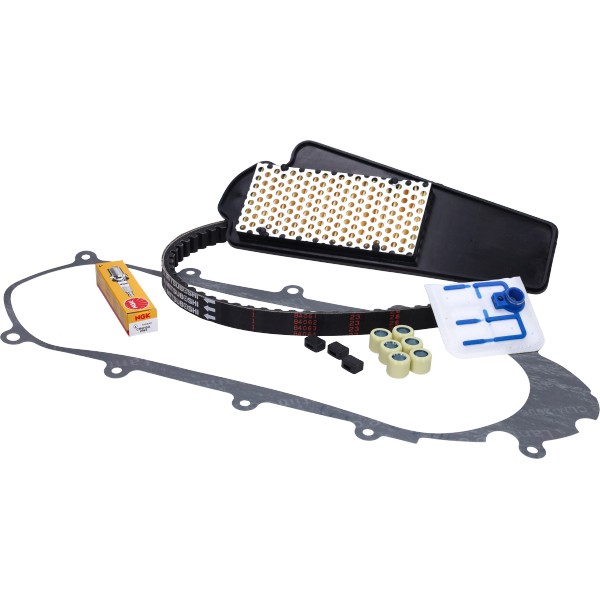
A service is a fixed round, from the fluids to the wear parts; below you work through it for a 4-stroke automatic scooter. What and when are covered in the scooter maintenance hub and in the maintenance schedule for your model; here it is about the how.
Preparation
Warm the scooter up for five to ten minutes: warm oil is thin and takes the dirt with it. Put it on the centre stand: then the level is correct and the drive spins freely. The engine is hot, so wear gloves. Keep the workshop manual for your model to hand: quantities, clearances and torques are only found there.
1. Engine oil, oil strainer and oil filter
- Put a drain pan ready and first loosen the filler cap or dipstick; then the oil drains out more completely.
- Undo the drain bolt and catch the sealing washer. Milky oil points to water, glittering particles to wear: then there is more going on.
- Behind the drain opening, many four-stroke engines have a small strainer with a spring. Rinse it in degreaser until you can see through it and refit it in the same order; a paper cartridge you replace, with the O-ring lubricated.
- Reinstall bolt with new washer, moderately tight: the thread is in aluminium, so adhere to the tightening torque specified in the manual.
- Fill the specified quantity, on a 50cc four-stroke usually under a litre. Run it for half a minute, switch off, wait a moment and read the level with the vehicle on its stand: a dipstick is simply rested in loosely.
Which type your engine block needs: which oil for your scooter.
2. Transmission oil — the forgotten service
The drive hub behind the variator has its own oil bath, separate from the crankcase. There are two bolts: the lower one is the drain, the upper one the filler. Drain, tighten the lower bolt again and fill the specified amount; on a 50cc automatic around 100 ml is usual. It is hypoid gear oil (often 80W-90), not engine oil; milky means a leaking oil seal.
3. Air filter
Foam you wash in warm soapy water, squeeze out (don't wring), leave to dry and lightly oil with filter oil. Paper and cotton gauze you don't wet: tapping out is fine, grey and clogged means replace. See cleaning the air filter and carburettor.
4. Spark plug
Unscrew the spark plug from a cold engine and read the tip: light brown to grey is healthy, black and sooty points to running too rich, chalk-white to too lean. Measure the electrode gap with a feeler gauge; 0,6 to 0,8 mm is usual for scooter spark plugs, your own value is in the manual; a rounded centre electrode is worn. Screw the new one in by hand, otherwise you will cross-thread the aluminium head. See choosing the right spark plug.
5. Brakes
Look through the brake caliper at the friction material: as a rule of thumb, replace below about 1,5 mm, always as a set per wheel. With a drum brake, read the wear indicator on the brake backplate. With a hydraulic brake, check the level and the colour: fresh is light straw yellow, brown or cloudy means it needs changing. See replacing brake pads and, for a spongy lever, bleeding the brakes.
6. Drive belt and variator roller weights
Take off the variator cover and use a calliper to measure the width of the drive belt at its widest point and compare it with the new dimension or the wear limit in the manual; cracks between the teeth or shiny sides mean replace it. Roll the variator roller weights across a flat surface: you will feel a flattened side straight away. They wear as one set, so replace them together — replacing the drive belt and choosing variator roller weights.
7. Tyres, cables, electrics and bolts
- Tyres — check the pressure cold according to the sticker under the seat; legal minimum tread depth 1 mm, and the DOT code gives the week of production.
- Cables — the throttle grip must spring closed by itself; lubricate, and replace if stiff or frayed.
- Electrics — lighting, brake light on both levers, indicators, horn, battery terminals.
- Bolts — wheel axles, exhaust, centre stand, side stand.
- Test ride — a short, gentle ride around the block, then check the drain bolt and hub for leaks.
What you need for a service
- Engine oil of the specified type and a new sealing ring.
- Oil filter or a cleaned strainer.
- Transmission oil and a bottle with a spout.
- Air filter element, or filter oil for a foam filter.
- Spark plug in the correct code and a feeler gauge.
- Brake pads or brake shoes and brake fluid of the correct grade.
- Drive belt and variator roller weights for sizes outside the limit.
- Tools: socket wrenches, torque wrench, calliper, voltmeter, drain pan.
- The workshop manual for your model.
The right parts straight away
Oil round: engine oil, oil filters and the lubricants and the transmission oil. Also air filter elements, spark plugs, brake pads, brake fluid, drive belts and variator roller weight sets — filter on the left by your brand and model. Further reading: scooter maintenance, which oil, adjusting the valves for a ticking engine, and the FAQ.


